Off-target confirmation service
Confirm your on- and off‑target edits, from coordinates to report.
You define the targets. We design the panel, run LockSeq in our lab in Solna, Stockholm and deliver an analyzed report in 15 business days. No instrument investment, no bioinformatics overhead.
LockSeq report · results
Illustrative data290 / 300
sites reportable
1
off-target edit found
| Site | Edited | Control | Call |
|---|---|---|---|
| DP-001 on-target | 71.3% | 0.00% | Edited |
| DP-187 off-target | 0.23% | 0.00% | Edited |
| DP-069 off-target | 0.52% | 0.58% | In control |
| DP-004 off-target | 0.00% | 0.00% | No variant |
Trusted by teams at





LockSeq has been instrumental in scaling our validation panels for off‑target candidates, a key process in the safety assessment of our gene writing platform. The Countagen team's approachable expertise and dedicated support with data interpretation have added value to our research.
Marta Sanvicente García, PhD
Bioinformatics Scientist, Integra Therapeutics
The regulatory context
FDA draft guidance puts off‑target confirmation before the IND
The FDA's April 2026 draft guidance on genome editing safety asks for confirmatory testing at nominated off‑target sites, names probe‑based sequence enrichment among the methods, and expects these studies done before the original IND.
As panels grow, keeping sensitivity and complete target coverage gets harder. Missing sites are data blind spots that can turn into delays and regulatory risk. That confirmation step is what LockSeq does.
Nominate
Candidate sites from your nomination assay or in silico prediction.
Confirm with LockSeq
An independent, targeted readout of every nominated site in your edited samples.
Report
Edit frequencies per site, ready for your safety package.
How it works
What's included in every LockSeq study
An end-to-end service: you focus on your program, we deliver high-confidence edit detection.
01 · Scoping
Project scoping
We review your edit design, gRNAs and nominated off‑target coordinates, and add in silico nomination where needed. Usually within 24 hours.
02 · Panel
Panel design
Padlock probes for all your on‑ and off‑target loci, designed for 1,000+ sites per reaction. Add new targets later without redesigning the panel.
03 · Lab
Sequencing
Library prep and sequencing in our lab in Solna, Stockholm, on Illumina, MGI or Oxford Nanopore.
04 · Report
Consensus report
UMI-corrected VAF per site with indel profiling, coverage charts and raw data (FASTQ + BAM). 15 business days from DNA receipt.
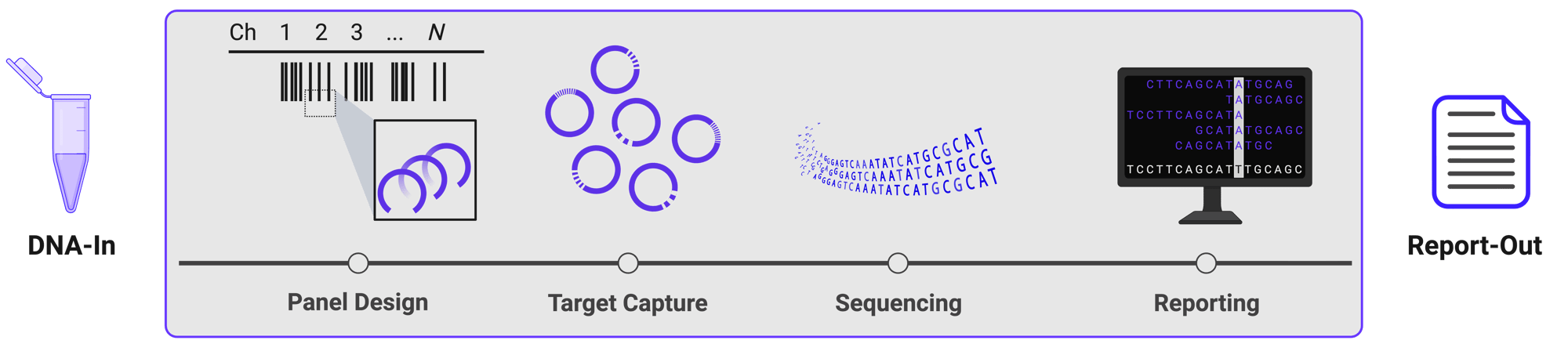
We review your edit design, gRNA sequences, and nominated off-target coordinates. Where needed, we can supplement with in silico nomination. Turnaround: Usually within 24 hours from first contact to project specification.
We design padlock probes for all your on- and off-target loci — up to 1,000+ sites per reaction. Probes are validated in silico before synthesis.
Mix-and-match of new targets across development stages without panel redesign.
LockSeq library preparation and sequencing are performed in our Stockholm laboratory. Illumina and Oxford Nanopore platforms confirmed.
You receive a UMI-corrected variant allele frequency report with indel profiling, coverage uniformity charts, and raw data (FASTQ + BAM). Standard turnaround: 15 business days from DNA receipt.
0.1%
VAF detection limit
1,000+
sites per reaction, by design
15 days
business days, DNA receipt to report
3
platforms: Illumina, MGI & ONT
Why LockSeq
Built so a sequencing error never reads as an off‑target
High-confidence edit detection
Every captured molecule gets a UMI before amplification, and reads are collapsed into one consensus call per molecule. Confident calls down to 0.1% VAF, with each site’s limit set by its own coverage.
Every site clearly reported
Sites we can't design for are flagged before you send samples. Every other site gets a clear status in the report, including any that drop out in the lab.
Small and large panels, same workflow
From a single site to large off‑target panels. Add targets without redesigning the assay.
High-Confidence Edit Detection
LockSeq uses gap-fill ligation to capture target molecules prior to amplification. UMI-based consensus sequencing suppresses technical errors, enabling confident detection of edits down to 0.1% VAF across panels exceeding 1,000 targets.
Fewer Dropouts. Better Coverage.
LockSeq is designed to minimize target dropout in highly multiplexed workflows. By reducing assay complexity and potential molecular interactions, the platform improves target representation and supports more complete genomic characterization across large panels.
One Workflow. Any Scale.
Reconfigure targets without assay redesign. LockSeq supports everything from single-site confirmation to >1,000-plex off-target characterization in a single workflow, with demonstrated compatibility across Illumina and ONT.
Pricing
Projects start from €1,000
For example, a panel of up to 25 sites with 2 samples. Price scales with sites and samples. Most projects are scoped within 24 hours.
Every quote includes: panel design · library prep & sequencing · UMI-corrected VAF per site · indel profiling · coverage charts · raw data (FASTQ + BAM)
Partners

Genome editing kits and reagents.
Off-target nomination with AutoDISCO.

Building LockSeq Mode for CRISPResso.