The Science Behind Reducing Amplification Bias
LockSeq captures and circularizes individual DNA molecules before amplification, preserving molecular identity from the start. By using a single probe per target, rather than multiple primers or overlapping probes, LockSeq simplifies target capture and reduces sources of bias and dropout
Three Steps to Accurate Target Capture

STEP 1 — HYBRIDIZATION
The padlock probe binds to flanking regions of the target site, leaving a intentional gap at the desired genomic locus (Hardenbol et al. 2005).
STEP 2 — GAP-FILL LIGATION
DNA polymerase fills the gap. DNA ligase seals the nick — but only if base pairing is exact. The result: a circular molecule representing a single original genomic fragment, uniquely tagged with a UMI.
STEP 3 — AMPLIFICATION & SEQUENCING
Circles are amplified and sequenced. UMI groups are collapsed into error-corrected consensus reads (Hiatt et al. 2013). Rare variants — down to 0.1% VAF — stand out clearly.
UMI-Native Consensus Calling
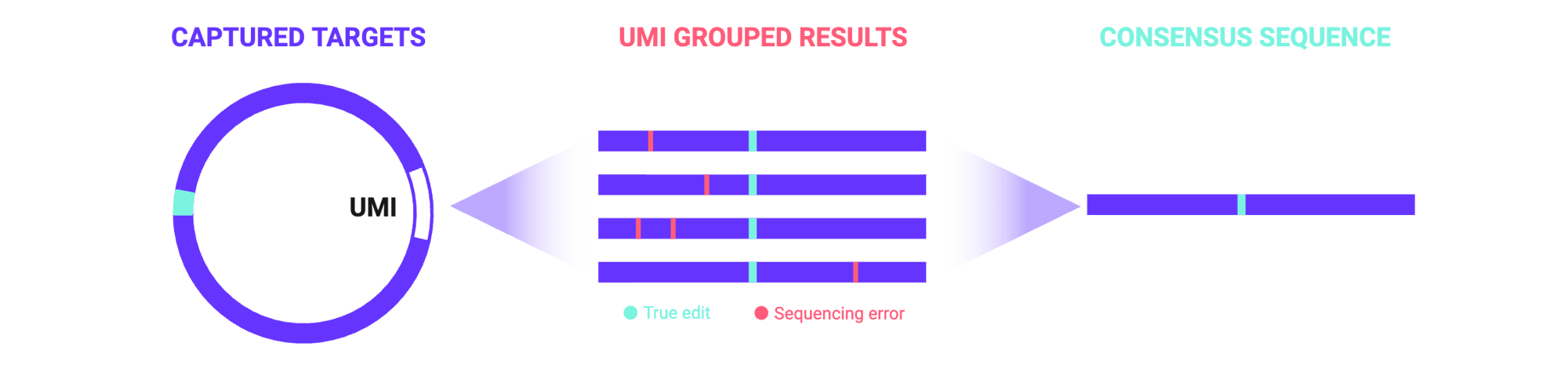
Every molecule captured by a LockSeq probe carries a unique barcode — its UMI — applied before any amplification. Reads sharing the same UMI are collapsed into a single consensus call, correcting for PCR-generated duplicates and sequencing errors (Hiatt et al. 2013).
The result: a minimized noise to resolve variants at 0.1% VAF with high confidence, across panels of 1,000+ sites.
LockSeq Enables High-Fidelity NGS-Based On- and Off-Target Confirmation
Accuracy
Enables quick and accurate on- and off-target gene editing confirmation at scale
Data Integrity
Minimizes dropouts and delivers uniform target coverage
Panel Flexibility
Modular panel design compatibility enables flexibility across development stages
Ready to Run Your Off-target confirmation Panel?
Send us your nominated off-target site coordinates and we'll scope a project within 24 hours.