One Probe, Every Nominated Site — Off-Target Confirmation at Scale
Multiplex PCR panels lose sites to primer competition — dropout you don't see until the data's already back. LockSeq uses single-molecule probes, one per target, so there's nothing left to compete against. 0.1% VAF sensitivity. 1,000+ sites in one pooled reaction.
Most Off-Target Data Has Gaps. LockSeq's Consensus Sequencing Closes Them.
Multiplex PCR-based methods — the most common approach behind NGS off-target panels — run dozens or hundreds of primer pairs in the same reaction. The primers compete. Some pairs win. Others fail to amplify at all.
That's target dropout. Published benchmarks on large panels have shown it reaching well into the double digits, percentage-wise.
Missing sites isn't just an assay inefficiency. For IND-enabling submissions, it's a regulatory exposure. For research programs, it's reproducibility risk.
LockSeq was designed to solve this. One probe per target. Nothing to compete against. Far less room for bias.

How LockSeq Compares
LockSeq uses gap-fill padlock probes: one probe locks onto one target molecule before amplification, so targets don't compete for reagents the way they do in multiplex PCR. That single design choice is what drives three measurable differences.
Sensitivity. LockSeq resolves variants down to 0.1% VAF (1:1,000) — a UMI-consensus call, not a raw read count. Multiplex PCR-based methods typically confirm reliably around 1% VAF; droplet-based digital PCR can go lower, but only one site at a time.
Scale. LockSeq runs 1,000+ sites in a single pooled reaction. Multiplex PCR-based panels commonly top out in the low hundreds before dropout becomes unmanageable. Digital PCR doesn't multiplex at all — it's built for single-site quantification, not panel-scale confirmation.
Coverage completeness. This is where the real gap shows up — see the data below.
Sensitivity
0.1% VAF (1:1,000)
Scale
1,000+ sites
Coverage completeness
Reduced target dropout
A Case Study Across Five Panels
We ran LockSeq directly against a multiplex PCR benchmark across five independent panels — 274 target sites in total.
LockSeq recovered 80% of the sites the benchmark failed to call. LockSeq's own dropouts were infrequent — 17 of 274 sites total — concentrated in two panels. Four of those, in one panel, are sites the benchmark could only detect as separate singleplex reactions, not in a pooled multiplex format — exactly the format LockSeq recovered them in.
This wasn't a single lab comparison. It's aggregated data across five real panels.
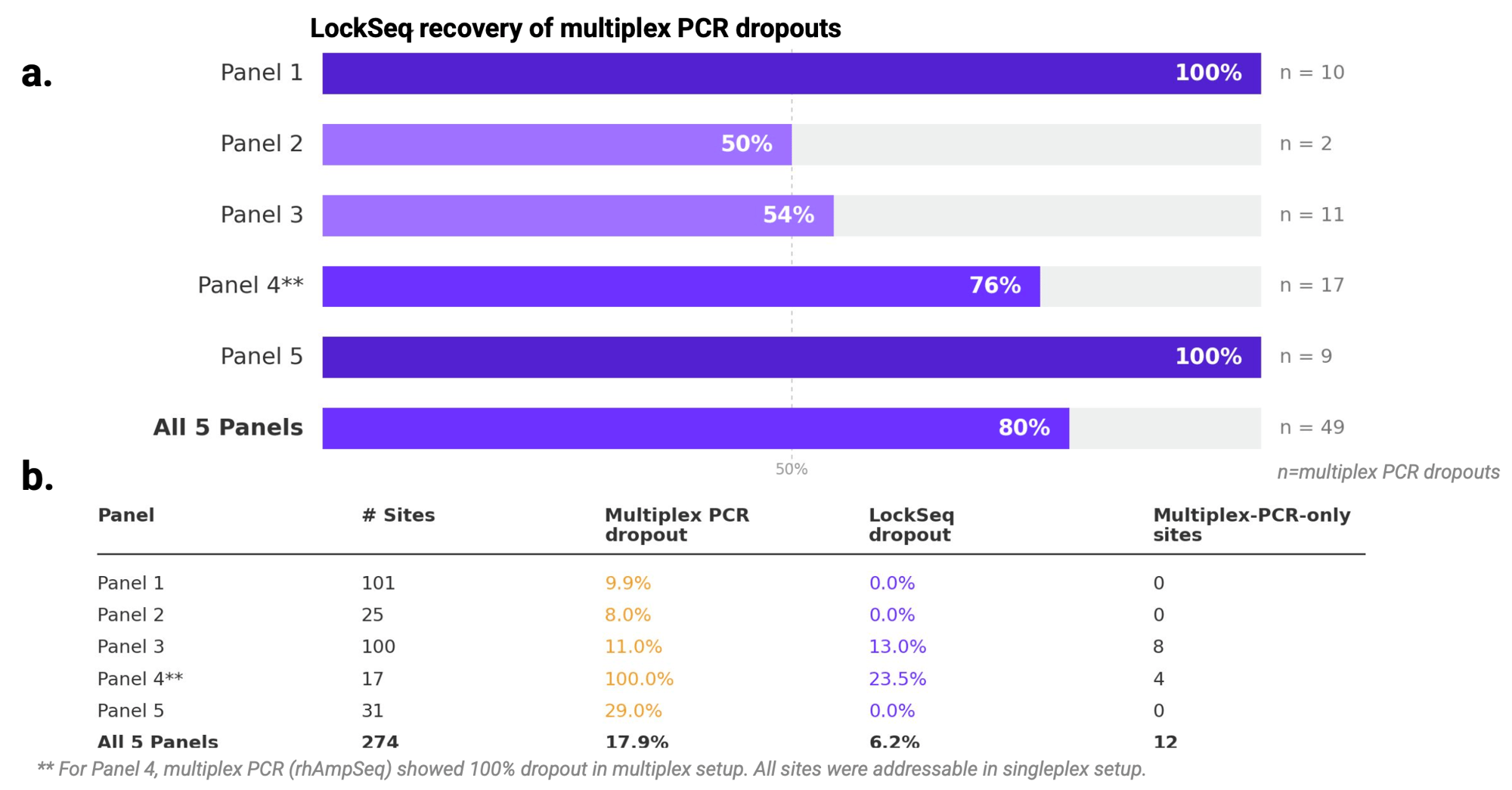
LockSeq vs. a multiplex PCR benchmark across 5 independent panels (274 target sites). LockSeq recovered 80% of the benchmark's dropout sites; LockSeq's own dropouts (17/274) were concentrated in two panels.
Which Method Is Right For Your Program?
LockSeq is the default choice for panel-based off-target confirmation — nominated sites, one pooled reaction, no per-site optimization.
Digital PCR is the exception: when you need the lowest possible detection floor on one specific locus and can run it in isolation, it's built for that in a way a panel method isn't.
Multiplex PCR-based panels still get used at the confirmation stage, but the same dropout and bias risk applies whatever the panel size — it's just easier to miss on a small one. FDA's April 2026 draft guidance names probe-based sequence enrichment as one of its accepted confirmatory approaches, alongside targeted sequence amplification — method-neutral, not an endorsement, but worth knowing before locking in a PCR-based method for a program heading toward IND.
Wherever site completeness matters — IND-enabling submissions, or any program where a missed site isn't an acceptable risk — LockSeq is built for it.