China's Orders 818 and 828, off-target expectations on the drug and hospital routes, and the genetic-resources rules for samples and data, from the primary texts.
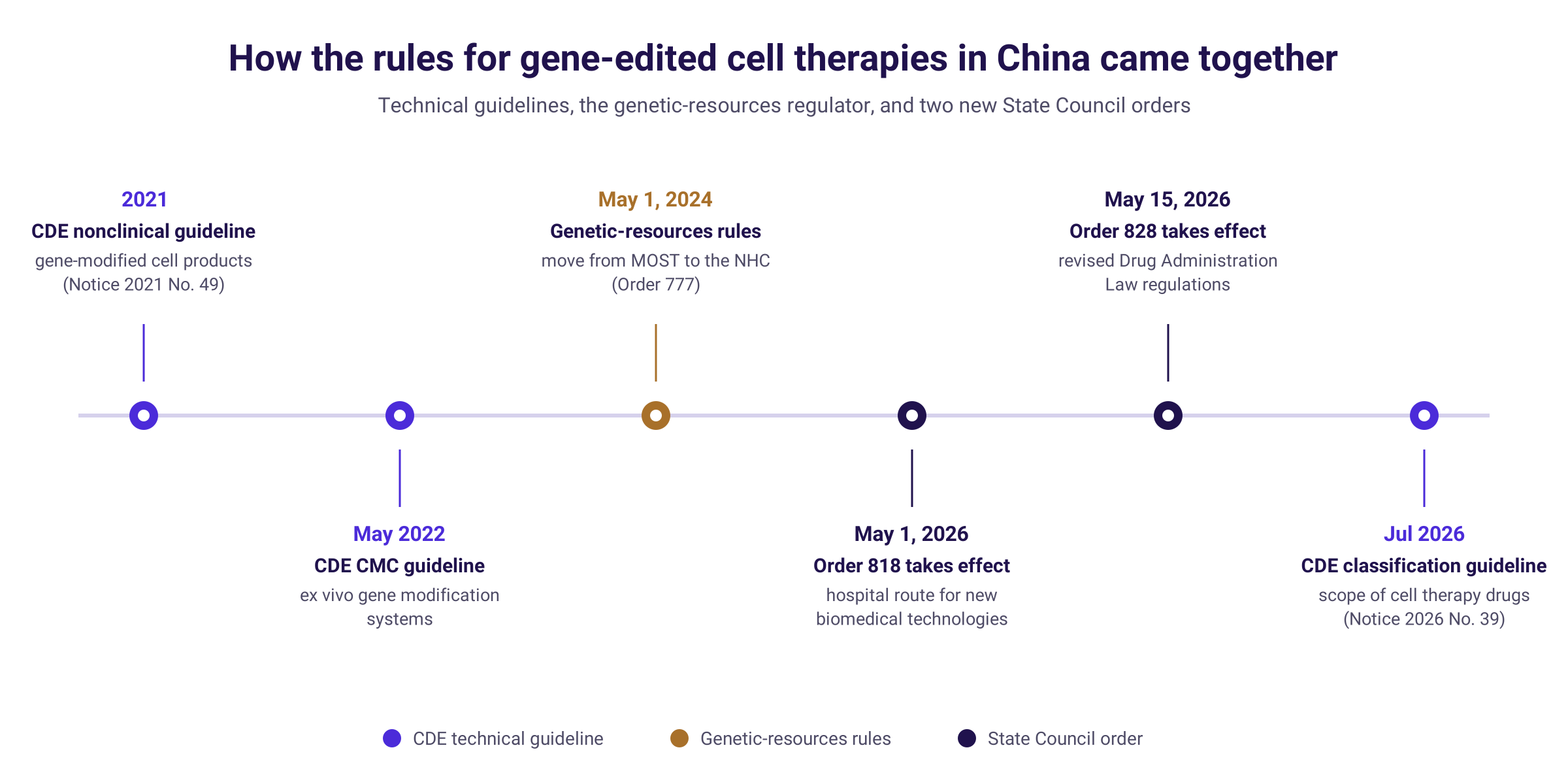
Two State Council regulations took effect in China in May 2026, a few weeks apart. Together with CDE technical guidelines, the filing guides issued under Order 818, and China's human genetic resources rules, they set out how a gene-edited cell therapy gets from the lab to patients in China. Here is what the texts actually say.
Two routes to the clinic
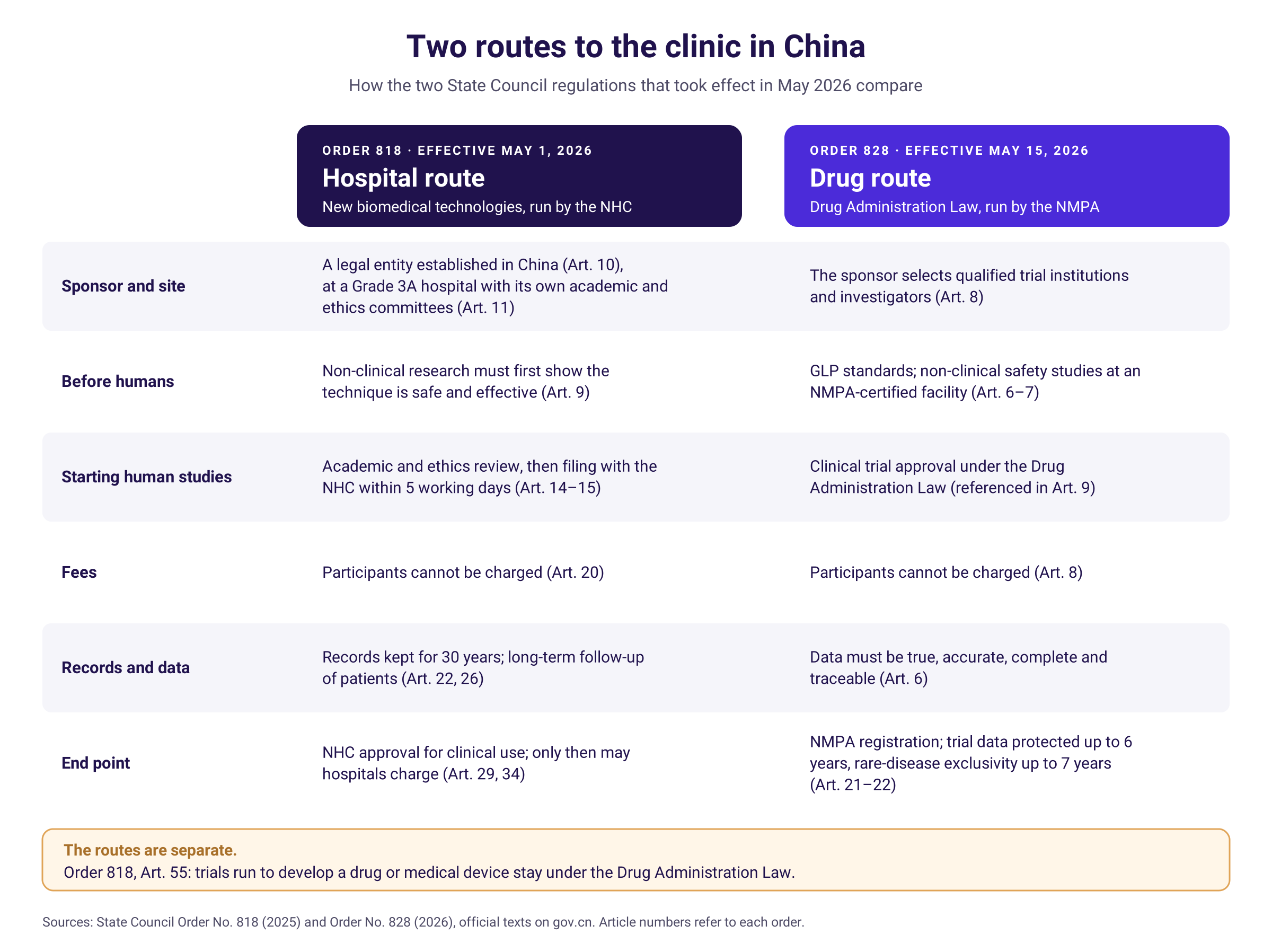
Order No. 818, the Regulations on the Administration of Clinical Research and Clinical Translation of New Biomedical Technologies, was signed on September 28, 2025 and took effect on May 1, 2026. It covers medical techniques that act on human cells or molecules and are not yet in clinical use in China (Art. 3). That includes manipulating cells outside the body and returning them to a patient (Art. 8).
The route is hospital-based:
- The sponsor must be a legal entity established in China (Art. 10).
- The study must run at a Grade 3A hospital with its own academic and ethics committees and stable research funding (Art. 11).
- Non-clinical research must first show the technique is safe and effective (Art. 9).
- The hospital files the study with the National Health Commission (NHC) within 5 working days of passing review (Art. 15).
- Participants cannot be charged (Art. 20).
- Records must be kept for 30 years (Art. 22), and patients must be followed up for long-term safety and efficacy (Art. 26).
Moving into routine clinical use requires NHC approval (Art. 29). Only after that approval can hospitals charge for the technique (Art. 34). Running prohibited research carries fines of up to RMB 10 million, or 10 to 20 times any illegal gains above RMB 1 million (Art. 43).
Order 818 sits alongside the drug route. Article 55 says trials run to develop a drug or device stay under the Drug Administration Law. It also tasks the NHC and NMPA with jointly issuing guidance on where the line between the two routes falls.
Order No. 828, the revised Implementing Regulations of the Drug Administration Law, was signed on January 16, 2026 and took effect on May 15, 2026. For drug developers, these provisions stand out:
- Development must follow GLP and GCP, with records and data that are "true, accurate, complete and traceable" (Art. 6).
- Non-clinical safety studies supporting registration must be done by an NMPA-certified facility (Art. 7).
- Data generated abroad can support a China registration if it meets NMPA requirements (Art. 10).
- Undisclosed trial data is protected for up to 6 years (Art. 22).
- Qualifying rare-disease drugs can receive up to 7 years of market exclusivity (Art. 21).
Where gene-edited cells sit
In July 2026, the CDE (NMPA's Center for Drug Evaluation) published its guideline on the scope and classification of cell therapy drugs (Notice 2026 No. 39). Cells genetically modified outside the body form their own subcategory of cell therapy drugs, developed and regulated along the drug pathway. The examples it gives include ex vivo CAR-T, ex vivo TCR-T and gene-modified hematopoietic stem cell products. In vivo approaches such as in vivo CAR-T fall outside the cell therapy category. The guideline also states that cell therapy development using Chinese human genetic resources must follow the genetic-resources rules covered below. It does not discuss Order 818.
What the guidance asks for on off-target editing
On the drug route
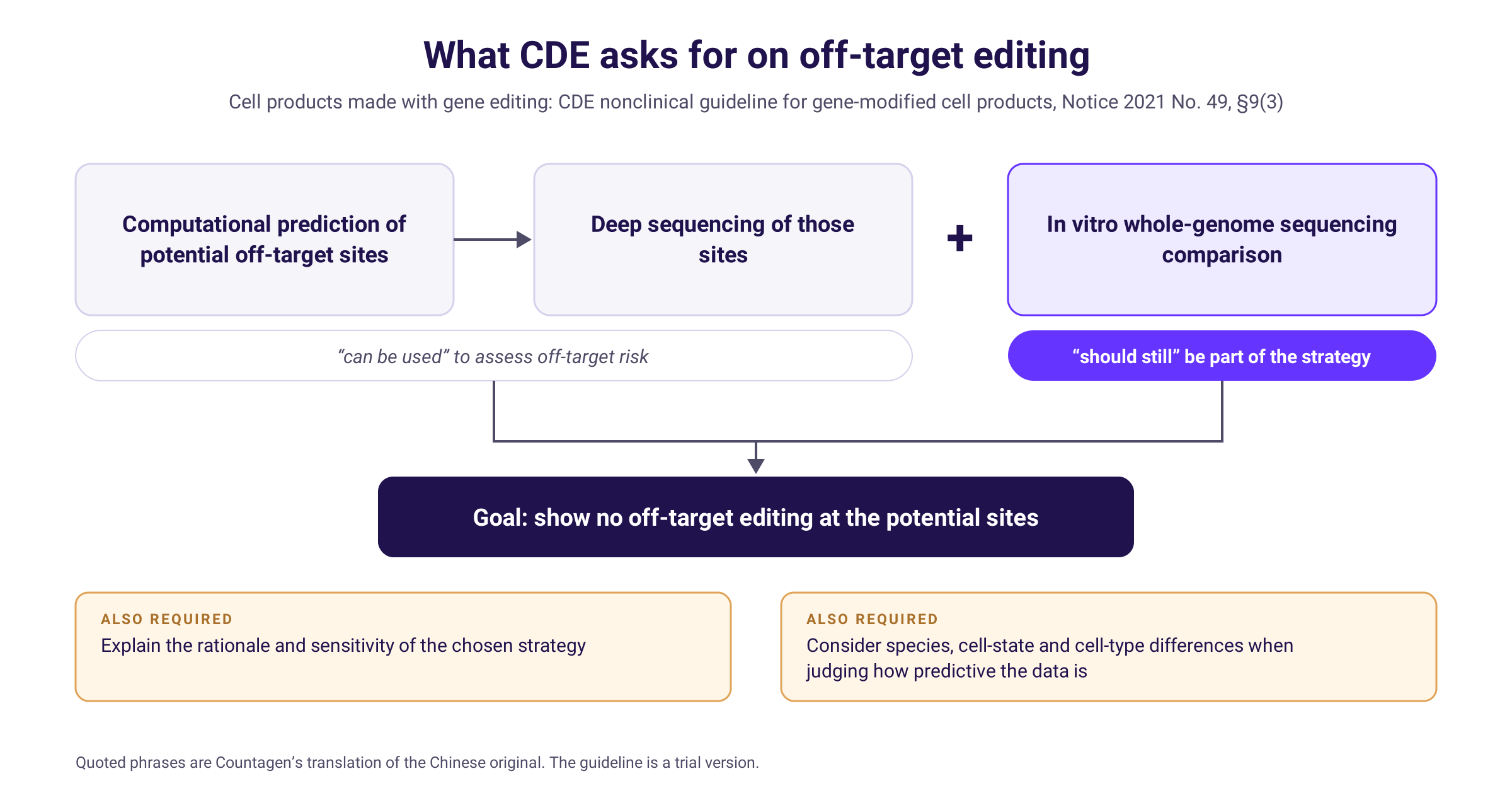
The most specific text is CDE's nonclinical guideline for gene-modified cell therapy products (trial version, Notice 2021 No. 49). For cell products made with gene editing, it asks for in vitro on-target and off-target activity studies to confirm the editor's specificity. Sponsors must explain why they chose their evaluation strategy and how sensitive it is.
The guideline is direct about method. Computational prediction followed by deep sequencing of candidate sites "can be used," but the strategy "should still include in vitro whole-genome sequencing comparison" to show that no off-target editing has occurred at the potential off-target sites. Sponsors should also consider how species, cell state and cell type affect how well the nonclinical data predicts what happens in patients.
CDE's 2022 CMC guideline for ex vivo gene modification systems (trial version) adds manufacturing-side expectations:
- It lists genotoxicity from on- and off-target editing as a product risk.
- It asks for specificity to be confirmed in relevant cells.
- It asks for residual editing components in the final product to be monitored.
The guideline describes itself as non-mandatory: applicants may propose alternative approaches with justification.
On the hospital route
On April 30, 2026, the China National Center for Biotechnology Development (CNCBD) published technical filing guides for research under Order 818. They apply to clinical research "not for the purpose of drug registration" (§2), and two of them cover gene editing:
- Gene therapy guide. It covers nucleic acids delivered inside the body. For DNA editing, it says whole-genome sequencing "should" be used for off-target analysis, combined with prediction algorithms and validation methods, with off-target frequency thresholds quantified (§6.2.3).
- Somatic cell therapy guide. It covers cells modified outside the body, such as CAR-T. It asks for off-target editing risk to be studied and controlled (§5.5.8), and suggests in vitro or in vivo off-target detection methods to verify it, with computer predictions as supporting evidence (§6.2.4).
Both guides are version 1 and say they will be revised as the field develops.
Samples and data leaving China
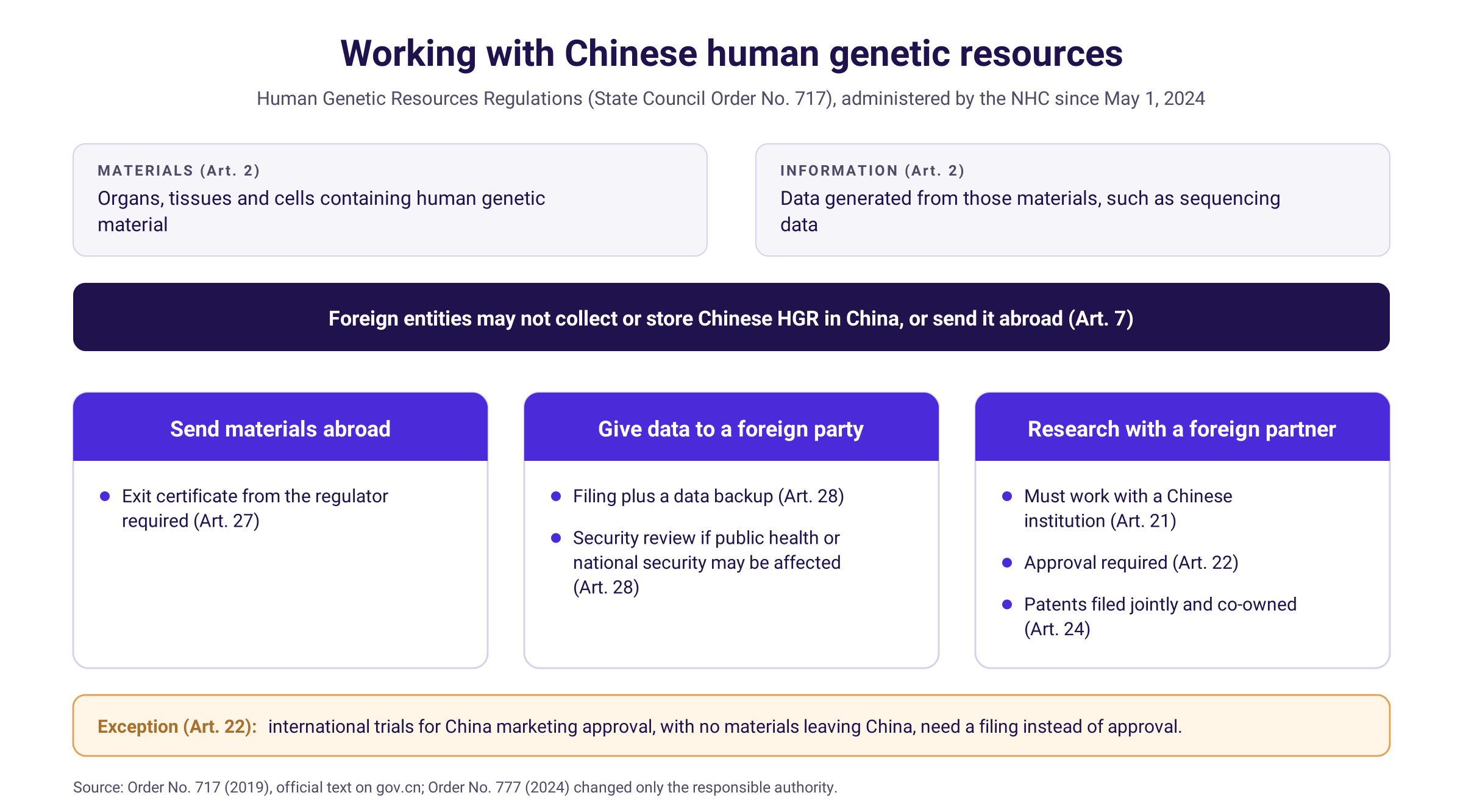
China's Human Genetic Resources Regulations apply to two things (Art. 2):
- Materials: organs, tissues and cells that contain human genetic material.
- Information: data generated from those materials.
The NHC has administered these rules since May 1, 2024, when Order No. 777 took responsibility away from the Ministry of Science and Technology. Four provisions matter most for foreign developers:
- No independent work by foreign entities. Foreign organizations, and entities they set up or control, cannot collect or store Chinese human genetic resources or send them abroad (Art. 7). Research use requires a partnership with a Chinese institution (Art. 21).
- Materials need an exit certificate. Moving materials out of China requires one from the regulator (Art. 27).
- Data needs a filing. Providing information to foreign parties requires a filing and a data backup, plus a security review where public health or national security could be affected (Art. 28).
- Patents are co-owned. In international collaborations, patents arising from the work are filed jointly and owned by both partners (Art. 24).
There is one exemption. International trials run to obtain marketing approval in China, where no materials leave the country, need a filing rather than an approval (Art. 22).
The net effect
Taken together, the texts describe two separate routes. Order 818 covers hospital-based technologies; Order 828 and CDE guidance cover drug products. Both routes now have written off-target expectations: CDE's guidelines on the drug side, the CNCBD filing guides on the hospital side. China's genetic-resource rules govern where samples and sequencing data can go on either route.
If you're planning a gene-edited cell therapy program that touches China and want to talk through off-target confirmation, get in touch.
Sources
- State Council Order No. 818, Regulations on the Administration of Clinical Research and Clinical Translation of New Biomedical Technologies (2025), full text — gov.cn
- State Council Order No. 828, Implementing Regulations of the Drug Administration Law (2026 revision), full text — gov.cn
- CDE, Technical Guideline on the Scope and Classification of Cell Therapy Drugs (2026 Edition), Notice 2026 No. 39 — cnpharm.com
- CDE, Technical Guideline for Nonclinical Research of Gene-Modified Cell Therapy Products (Trial), Notice 2021 No. 49 — cnpharm.com
- CDE, Technical Guideline for CMC Study and Evaluation of ex vivo Gene Modification Systems (Trial), May 2022, English version — ccfdie.org
- CNCBD, Filing Guide for Clinical Research of New Gene Therapy Technologies (Version 1), April 2026 — cncbd.org.cn
- CNCBD, Filing Guide for Clinical Research of New Somatic Cell Therapy Technologies (Version 1), April 2026 — cncbd.org.cn
- State Council Order No. 717, Regulations on the Administration of Human Genetic Resources (2019), full text — gov.cn
- State Council Order No. 777, Decision on Amending and Repealing Certain Administrative Regulations (March 2024), item 4: HGR authority changed to the NHC, effective May 1, 2024 — full text reprinted by the Ministry of Ecology and Environment — mee.gov.cn
Chinese quotes are Countagen's translation.