FDA's April 2026 draft, EMA's guidelines and China's drug-route and hospital-route texts compared: what each asks for in off-target studies, section by section.
FDA published draft guidance on off-target assessment for genome-edited products in April 2026. In the EU, EMA's expectations sit in two scientific guidelines: one for medicinal products containing genetically modified cells (2021) and one for investigational advanced therapies in clinical trials (2025). In China, a gene-edited therapy can reach patients by two routes. The drug route runs through China's Center for Drug Evaluation (CDE). The hospital route, governed by State Council Order No. 818 since May 1, 2026, has filing guides published on April 30, 2026 by the China National Center for Biotechnology Development (CNCBD). This post sets them side by side.
FDA has since issued two related drafts, on leveraging prior knowledge (June 2026) and on individualized products (October 2026). We cover how they connect to the April draft in a separate post.
Three caveats before the comparison:
- Different scope.
- FDA's draft covers genome-edited gene therapy products, ex vivo and in vivo, including epigenome and RNA editors (§III).
- EMA's 2021 guideline covers cells modified with genome-editing tools (§2). Its 2025 clinical trial guideline adds in vivo editing (§4, S.3.1).
- CDE's 2021 nonclinical guideline covers gene-modified cell therapy products (§2).
- The CNCBD guides are split by technology. The gene therapy guide covers nucleic acids delivered inside the body. The somatic cell therapy guide covers cells manipulated outside the body, including genetic modification, and returned to the patient (§2 of each).
- Different purpose. The CNCBD guides apply to clinical research in China that is "not for the purpose of drug registration" (§2). A program heading for NMPA approval follows the drug route.
- None is binding in the way a law is.
- FDA's draft is marked "not for implementation", and its comment period closed on July 14, 2026.
- EMA's scientific guidelines are not legally binding. The 2021 guideline calls its product-class recommendations "points for consideration rather than prescriptive guidance" (§5.3).
- CDE's guideline is a trial version.
- The CNCBD guides are version 1 and say they will be revised as the field develops.
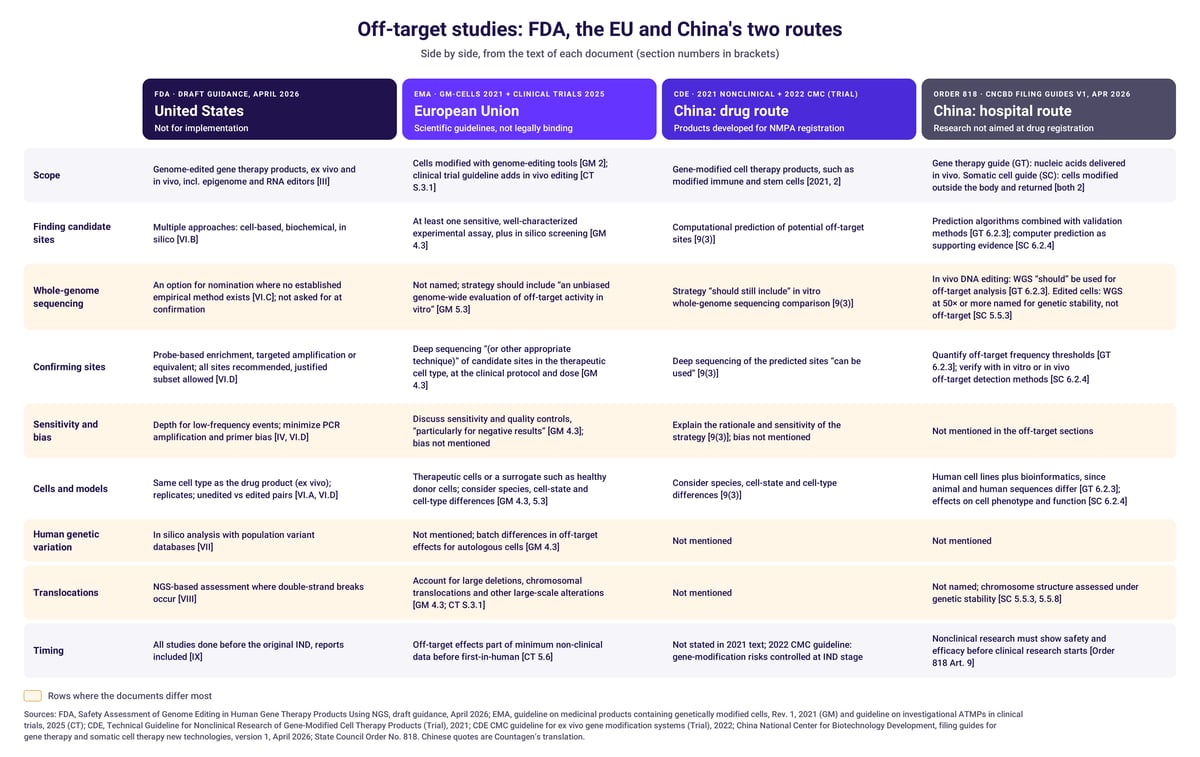
Where all four meet
All four put off-target work before the clinic and ask for it in human-relevant systems.
- FDA wants ex vivo studies done in the same cell type that is edited to make the drug product (§VI.A).
- EMA asks for candidate sites to be "interrogated by deep-sequencing (or other appropriate technique) in the actual cell type to be used therapeutically", treated with the proposed protocol and nuclease dose (2021 guideline, §4.3). Its clinical trial guideline lists off-target effects in the minimum non-clinical data before first-in-human (§5.6).
- CDE asks for in vitro on- and off-target activity studies, and for sponsors to consider how species, cell state and cell type affect what the data predicts in patients (§9(3)). EMA's 2021 guideline lists the same three factors (§5.3).
- The CNCBD gene therapy guide makes the same point from the other direction. Animal and human gene sequences differ, so it asks for a multi-layer, complementary strategy built on human cell lines and bioinformatics (§6.2.3).
- The CNCBD somatic cell guide asks for off-target editing risk to be studied and controlled (§5.5.8), and for its effect on cell phenotype and function to be assessed (§6.2.4).
Where they differ
Whole-genome sequencing. This is the clearest split.
- CNCBD gene therapy guide (in vivo): for DNA editing, whole-genome sequencing "should" be used for off-target analysis, combined with prediction algorithms and validation methods, and off-target frequency thresholds should be quantified (§6.2.3).
- CDE (ex vivo cells, drug route): computational prediction plus deep sequencing of candidate sites "can be used", but the strategy "should still include in vitro whole-genome sequencing comparison" (§9(3)).
- CNCBD somatic cell guide (ex vivo cells, hospital route): the off-target section doesn't name whole-genome sequencing. It suggests in vitro or in vivo off-target detection methods, with computer predictions as supporting evidence (§6.2.4). Whole-genome sequencing appears elsewhere in the guide, at 50× or more, for genetic stability (§5.5.3).
- EMA: neither guideline names whole-genome sequencing. The 2021 guideline asks for the strategy to "include an unbiased genome-wide evaluation of off-target activity in vitro" (§5.3).
- FDA: genome-wide NGS is one way to nominate candidate sites, mainly where no established empirical method exists (§VI.C). Its confirmation section lists targeted methods (§VI.D) and doesn't ask for whole-genome sequencing.
Confirming candidate sites.
- FDA names "probe-based sequence enrichment, targeted sequence amplification, and/or other equivalent methods", recommends testing all nominated sites and allows a justified subset (§VI.D).
- EMA asks for deep sequencing or another appropriate technique in the therapeutic cells, and for sensitivity and quality controls to be discussed, "particularly for negative results" (§4.3).
- CDE accepts deep sequencing of predicted sites (§9(3)).
- The CNCBD gene therapy guide asks for off-target frequency thresholds to be quantified (§6.2.3).
Breadth. FDA's draft has dedicated sections on topics the other texts treat differently or not at all:
- Human genetic variation: FDA asks for in silico analysis against population variant databases (§VII). EMA asks for differences in off-target effects between batches of autologous starting material to be evaluated (§4.3). Neither CDE's 2021 text nor the CNCBD off-target sections mention genetic variation.
- Chromosomal translocations:
- FDA asks for NGS-based assessment where double-strand breaks occur (§VIII).
- EMA asks for large deletions, chromosomal translocations and other large-scale alterations to be accounted for (2021, §4.3), and for edited cells to be analyzed for rearrangements (2025, §4, S.3.1).
- The CNCBD somatic guide assesses chromosome structure under genetic stability (§5.5.3, §5.5.8), without linking it to editing.
- Amplification bias: FDA asks for strategies to minimize PCR amplification and primer bias (§IV). EMA's guidelines, CDE's 2021 text and the CNCBD off-target sections don't mention it.
- Sample design: FDA asks for multiple biological replicates, plus paired unedited and edited samples (§VI.A, §VI.D). EMA's guidelines don't mention replicates.
Timing.
- FDA recommends that the off-target and translocation studies be completed before the original IND, with a detailed study report submitted with it. Studies accounting for human genetic variation may not be needed at that point in some cases, such as an ultra-rare disease or a single-patient treatment (§IX).
- EMA's clinical trial guideline expects most non-clinical data before first administration to humans, with off-target concerns addressed under genotoxicity (§5.6).
- CDE's 2022 CMC guideline for ex vivo gene modification systems asks for gene-modification risks to be controlled at the IND stage.
- On the hospital route, Order 818 requires nonclinical research to show a technique is safe and effective before clinical research starts (Art. 9).
One assessed example
EMA's assessment report for Casgevy (exagamglogene autotemcel), which EMA's human medicines committee described as "the first medicine using CRISPR/Cas9", shows how one off-target package was built (§2.5.4.3):
- Nomination: in silico searches, including common genetic variants, and GUIDE-seq.
- Confirmation: hybrid capture sequencing of the candidate regions in healthy-donor and patient cells. The threshold went down to 0.2% at more than 10,000× coverage.
No off-target editing was confirmed.
Reading the four together
The texts don't line up one to one.
- Whole-genome sequencing: CDE's drug-route guideline and the CNCBD in vivo guide name it for off-target analysis. FDA's draft, EMA's guidelines and the CNCBD somatic cell guide don't ask for it at that step.
- Confirmation: FDA and EMA both describe a step that checks nominated sites in relevant cells.
- Breadth: FDA's sections on genetic variation, amplification bias and sample design have no direct counterpart elsewhere.
- What's next: EMA's Committee for Advanced Therapies plans new genome-editing guidance, with drafting starting in 2026 (CAT work plan 2026).
If you're planning an off-target package for a program headed to FDA, the EU, China or more than one, and want to talk through the confirmation step, get in touch.
Sources
- FDA, Safety Assessment of Genome Editing in Human Gene Therapy Products Using Next-Generation Sequencing, draft guidance for industry, April 2026 (docket FDA-2026-D-1255) — fda.gov
- Federal Register notice, April 15, 2026 (comment deadline July 14, 2026) — federalregister.gov
- EMA, Guideline on quality, non-clinical and clinical aspects of medicinal products containing genetically modified cells, EMA/CAT/GTWP/671639/2008 Rev. 1 – corr (effective June 1, 2021) — ema.europa.eu
- EMA, Guideline on quality, non-clinical and clinical requirements for investigational advanced therapy medicinal products in clinical trials, EMA/CAT/22473/2025 (effective July 1, 2025) — ema.europa.eu
- EMA, Casgevy public assessment report, EMA/6332/2024 — ema.europa.eu; CHMP meeting highlights, December 11–14, 2023 — ema.europa.eu
- EMA, Committee for Advanced Therapies work plan 2026 — ema.europa.eu
- CDE, Technical Guideline for Nonclinical Research of Gene-Modified Cell Therapy Products (Trial), Notice 2021 No. 49 — cnpharm.com
- CDE, Technical Guideline for CMC Study and Evaluation of ex vivo Gene Modification Systems (Trial), May 2022, English version — ccfdie.org
- CNCBD, Filing Guide for Clinical Research of New Gene Therapy Technologies (Version 1), April 2026 — cncbd.org.cn
- CNCBD, Filing Guide for Clinical Research of New Somatic Cell Therapy Technologies (Version 1), April 2026 — cncbd.org.cn
- State Council Order No. 818, Regulations on the Administration of Clinical Research and Clinical Translation of New Biomedical Technologies (2025) — gov.cn
Chinese quotes are Countagen's translation.